
Electronics
Electronics rated by the people who use them
Computers, storage, audio, cameras, phones, gaming, and smart-home gear, organised around how people actually shop.
Browse
- Computers and Accessories
- Audio
- Cameras and VideoSoon
- Phones and TabletsSoon
- GamingSoon
- Smart HomeSoon
15 products
 Apple AirPods Pro 2 (USB-C)Apple
Wireless Earbuds
Apple's noise-cancelling earbuds are designed to work most deeply inside the Apple ecosystem, with features such as personalised spatial audio and hearing assistance. The USB-C case also supports MagSafe, Apple Watch, and Qi charging. Fit, long-term battery ageing, and the value of the Apple-only conveniences are the evidence questions that matter. Not tested here yet.
 Apple Mac mini, M4 Pro, 24GB, 512GBApple
Mini PCs
Three of these run this site's own agent fleet, continuously, and the memory has never been the constraint. That is the opposite of the usual advice, which assumes models run locally; when the agents call APIs the model never touches your memory. Silent, and small enough to live in a room you work in. The internal disk cannot be upgraded, so 512GB is worth taking over 256GB.
- Audio-TechnicaAudio-Technica ATH-M50xAudio-Technica
Wired Headphones
A closed-back wired studio headphone with no battery, app, Bluetooth, or active noise cancellation. Its 38-ohm impedance makes it easier to drive from everyday equipment than many specialist headphones, while the closed cups provide some physical isolation. Pad durability and comfort over long sessions are the owner-evidence questions. Not tested here yet.
- BoseBose QuietComfort Ultra Headphones (2nd Gen)Bose
Wireless Headphones
Bose's second-generation flagship over-ear headphones focus on active noise cancellation and travel comfort. They can play audio over USB-C as well as Bluetooth and the included analogue cable, which makes them more flexible at a desk or on a flight. Battery life changes when Immersive Audio is enabled, so that setting belongs in any real-world comparison. Not tested here yet.
 Crucial T500 2TBCrucial
Internal SSDs
The sensible alternative to the 990 PRO for enclosure use. Both are PCIe Gen4 TLC drives quoting around 7,400 MB/s internally, and behind a USB4 bridge that difference disappears entirely. The gap that survives is warranty and endurance, so compare those rather than the headline speed. Not tested here yet.
- OWCOWC Express 1M2 USB4 EnclosureOWC
Storage Enclosures
Enclosure only, 40Gb/s USB4, in a solid aluminium body that is the heat sink. That last part is the reason to care: an NVMe drive in a small sealed box throttles under sustained writes, and sustained writes are exactly what an agent fleet produces overnight. Not tested here yet.
 Samsung 990 PRO 2TBSamsung
Internal SSDs
A fast PCIe 4.0 drive to put inside an enclosure. Worth knowing before you pay for the speed: the 7,450 MB/s on the box is what it does on an internal slot, and a USB4 enclosure caps well below that. Buy this for endurance and reliability, not for a number you will never see externally. Not tested here yet.
 Samsung T9 Portable SSD 2TBSamsung
Portable SSDs
A finished drive rather than a drive and a box: nothing to assemble, nothing to get wrong. The price is the interface. USB 3.2 Gen 2x2 tops out near 2,000 MB/s against USB4's 40Gb/s, and Macs have historically been awkward with Gen 2x2. For a machine that mostly needs somewhere to put things, that ceiling rarely matters. Not tested here yet.
- SatechiSatechi USB4 Slim NVMe SSD EnclosureSatechi
Storage Enclosures
40Gbps USB4, takes a 2230 to 2280 drive up to 8TB, and is built to sit under a Mac mini. The reason to own one is arithmetic: Apple charges a large premium per storage tier and the internal drive cannot be changed later. Not tested here yet.
 Sennheiser HD 600Sennheiser
Wired Headphones
A long-running open-back wired headphone intended for quiet rooms rather than commuting or shared offices. The open design leaks sound and blocks little outside noise, while the 300-ohm impedance can make a dedicated headphone amplifier useful. Its replaceable cable and modular parts give long-term ownership evidence unusual importance. Not tested here yet.
- SennheiserSennheiser Momentum 4 WirelessSennheiser
Wireless Headphones
A wireless over-ear alternative built around unusually long quoted battery life: up to 60 hours even with active noise cancellation enabled. It supports multipoint Bluetooth and can also work over a cable, making it suitable for comparing travel convenience with everyday desk use. Comfort and control behaviour matter as much as the headline endurance. Not tested here yet.
 Sony WF-1000XM5Sony
Wireless Earbuds
Sony's compact flagship earbuds offer active noise cancellation, multipoint pairing, and LDAC support alongside the standard SBC and AAC codecs. They are a useful cross-platform counterpoint to AirPods because their main features are available on both Android and iPhone. Secure fit and call quality still need owner evidence rather than specification claims. Not tested here yet.
 Sony WH-1000XM6Sony
Wireless Headphones
Sony's current flagship wireless over-ear headphones combine active noise cancellation with a foldable design, a wired input, and support for higher-quality LDAC audio on compatible devices. The practical comparison points are long-session comfort, microphone performance, and whether Sony's noise cancellation is worth the premium over simpler models. Not tested here yet.
- SoundcoreSoundcore Space OneSoundcore
Wireless Headphones
A mainstream wireless over-ear model with adaptive noise cancellation, multipoint pairing, and an analogue input. Its role in the catalogue is to test how much of the premium experience survives at a more accessible tier: comfort, call quality, and noise reduction are the questions the specification sheet cannot answer. Not tested here yet.
 TP-Link TL-SG105TP-Link
Networking
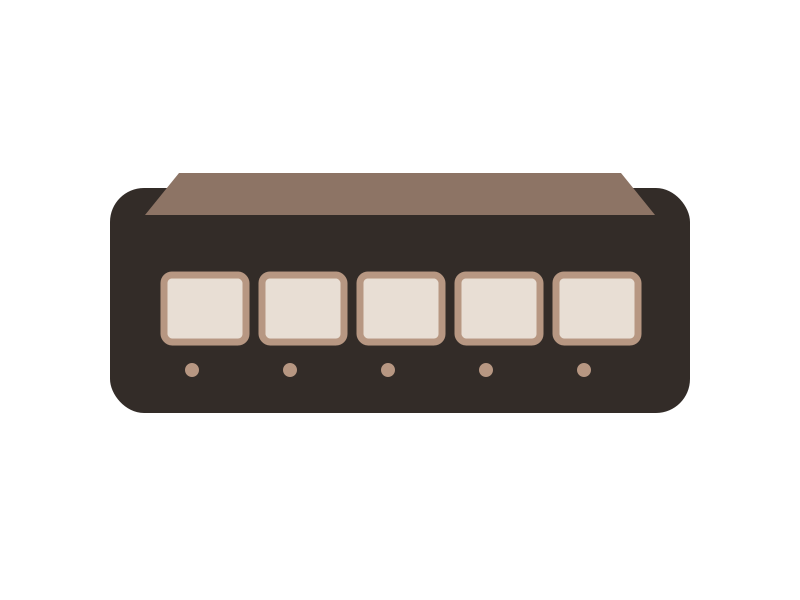
Five gigabit ports, unmanaged, fanless, metal. Unglamorous and correct for getting three machines off Wi-Fi and onto cable. Fanless matters if the machines share a room you work in. Not tested here yet.